flags

flags
Showing posts with label ROMANIA. Show all posts

25/10/2017

Links to internet newspapers and sites where we disseminated our project

Hi
This is a list of some of the online newspapers where we sent articles and other internet sites who published news about our project.

https://www.scribd.com/uploads  - where we uploaded the scanned books and PPTs


http://forum.didactic.ro/elevii-de-la-scoala-gheorghe-i-eica-promoveaz-tradi-iile-t24559.html#p217516


08/10/2017

Booklets about the Vikings and the Greeks


These are the two booklets the Romanian students have created, about the Greeks and the Vikings.


OTHER INVADERS OF ROMANIA

OTHER INVADERS OF ROMANIA

The military history of Romania deals with conflicts spreading over a period of about 2500 years across the territory of modern Romania, the Balkan Peninsula and Eastern Europe.
During antiquity, the territory of modern Romania was the scene of sporadic wars between the native Dacian tribes and various invaders (Persians, Macedonians, Celts or Romans). Ultimately, the Kingdom of Dacia was conquered by the Roman Empire in 106 and large parts of its territory became a Roman province. As the Roman Empire declined, Dacia was abandoned because of pressure from the Free Dacians and Goths.
For 1000 years, numerous migrating peoples including the  Goths,  Huns,  Gepids,  Avars,  Slavs,  Bulgars,  Magyars,  Cumans  and  Mongols   overran the territory of modern Romania. In the 13th century, a number of small Romanian states emerged and evolved into the medieval principalities of Moldavia, Wallachia and Transylvania.
During the Late Middle Ages, all three provinces had to deal with the danger posed by the growing power of the Ottoman Turks. John Hunyadi, Voivode of Transylvania and regent of Hungary managed to halt the Turkish advance into Central Europe and secured a major victory at the Battle of Belgrade in 1456. Stephen the Great of Moldavia, Mircea the Elder and Vlad the Impaler of Wallachia also successfully fought off the Turks and distracted them from the strategically more important objectives in the Mediterranean and the Balkans. However, by the middle of the 16th century, the three principalities had become Ottoman vassals. Michael the Brave of Wallachia managed to unite his realm with Transylvania and Moldavia and gain independence for a short time in 1600.
The early modern period was characterized by continuous warfare between the Habsburg Empire, Ottoman Empire, Poland (until the 18th century) and Russia for the control of the Danubian principalities and Transylvania. The defeat of the Ottomans at the Battle of Vienna in 1683 marked the beginning of their decline in the region.
The 19th century saw the formation of the modern Romanian state through the unification of Moldavia and Wallachia. Independence from the Ottoman Empire was secured after the Russo-Turkish War of 1877–1878 and Romania became a kingdom in 1881. The participation on the Allied (Entente) side during World War I triggered the unification of the remaining Romanian inhabited territories with the kingdom, thus forming Greater Romania.
Romania reached its zenith during the inter-war period. After World War II, it was reduced to its modern borders and fell in the Soviet sphere of influence, which lasted until the revolution, in 1989.


02/08/2017

FINAL DISSEMINATION

Hi

On the 13th of June we had a big dissemination activity at our school, where we invited parents, students, teachers from our school and other schools and representatives of the Constanta School Inspectorate. Each of our partner schools were represented, with traditional objects, food and books.
You can see some pictures:


01/08/2017

STUDENTS AND TEACHERS REFLECTIONS

Hi

These are the teachers and students reflections from Romania.

https://www.scribd.com/document/355263169/Teachers-Reflections-Questionnaire?secret_password=vcq75Iesp26GbXQwfRQX

https://www.scribd.com/document/355263561/Students-Reflections-Romania


enjoy!

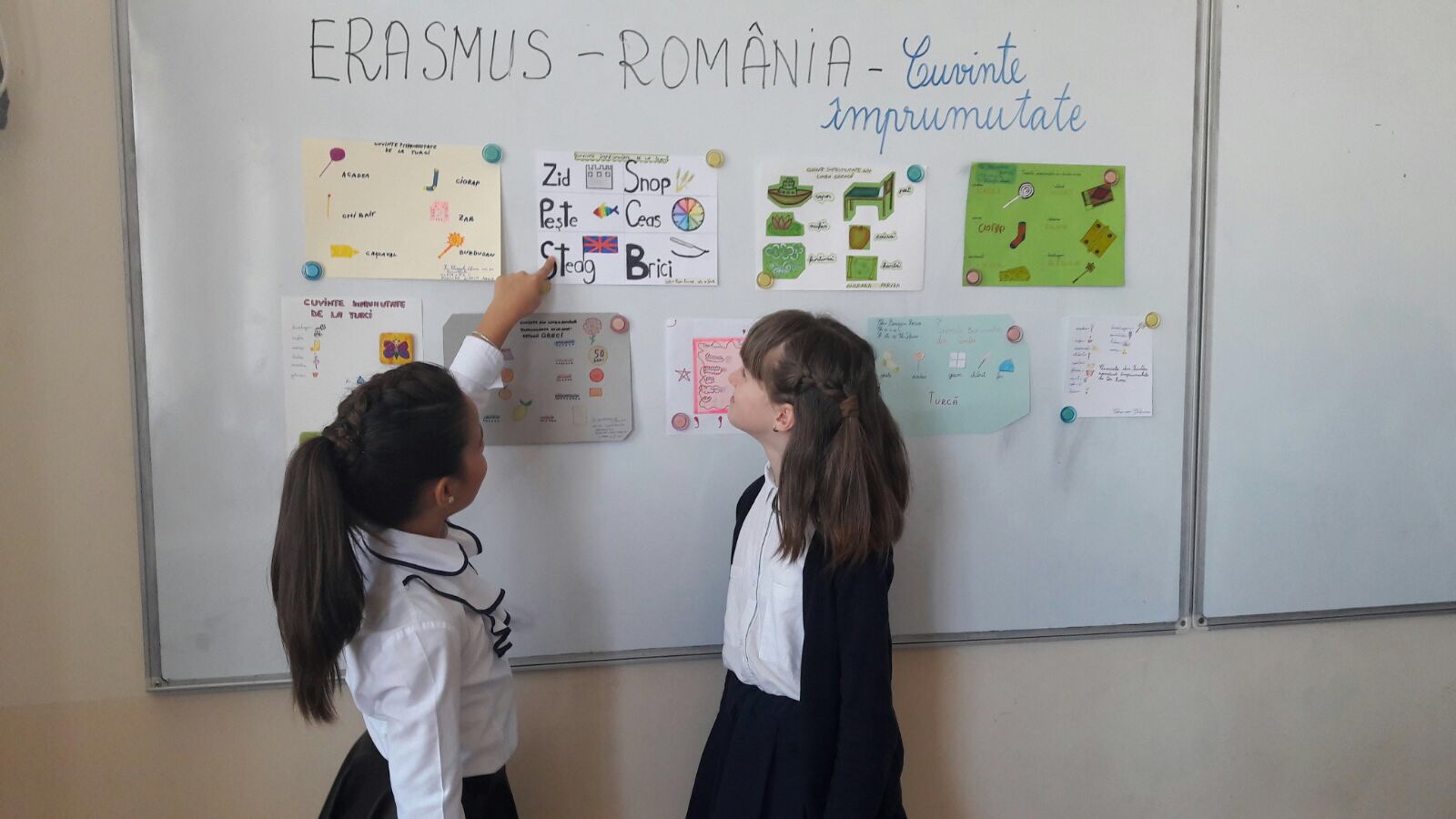
Working for the dictionary activity

Hi

Class 4C, with teacher Simona Palasca, had a very interesting and stimulating activity to prepare the words for the dictionary.
You can see some pictures from the activity.


FINAL SURVEY for students and teachers - JUNE 2017


Hi

These are the final evaluation questionnaires for students and teachers, from June 2017.

https://www.scribd.com/document/355258199/ANALYSIS-Erasmus-STUDENTS-FINAL-SURVEY-JUNE-2017

https://www.scribd.com/document/355258305/ANALYSIS-Erasmus-TEACHERS-FINAL-SURVEY-JUNE-2017


Teachers and students evaluation questionnaires from February 2016

Hi

These are the evaluation questionnaires for students and teachers from February 2016.

https://www.scribd.com/document/355257745/ANALISYS-Erasmus-STUDENTS-SURVEY-February-2016?secret_password=PFfusANcIWDG4LVDXdOl

https://www.scribd.com/document/355257869/ANALISYS-Erasmus-TEACHERS-SURVEY-February-2016?secret_password=xpWxJUpDSH8Xg8Ivhyv0

MOBILITY IN POLAND


Hi

This is a short presentation of our experience in Poland.

https://padlet.com/dorinasacu1/mt0nd6iu1f09

enjoy!

Transnational reunion - Ireland.


Hi

This is a short presentation of the transnational reunion from Ireland.

https://www.scribd.com/presentation/355255847/Dissemination-Ireland-transnational-reunion?secret_password=x9oTgoUpkrR77RxIRazT

enjoy


ONLINE DEBATE ROMANIA - FINLAND


Invasion is always a bad thing – debate with Finland – 21.02.2017


Maria
The invasion is always a bad thing beacause the two countries have to fight for the territory of the invaded county.
These little fights can become wars. The wars have really bad consequences. In wars, a lot of people die, some of the cities are affected. A lot of money are used for the weapons, for rebuilding the demolished buildings but also for meds, bandages and swaddles for treating the injured soldiers.
I think every country had to stay on their own territories and don't have to expand on other little countries which haven't resources to defand themselves.
Without wars, every people can have the chance to live in their own county and got to learn about their culture and speak their own language. This would not happen if the invations countinue.

Sarah

Invading a country has always been a bad thing, although peoples have been invading other peoples for years.

First of all, the invading country takes the freedom of all the people of the invaded country. Those people are denied their rights and if they fight they are sent to prison.

Secondly, all the riches of the invaded country are taken and sent to the invading country and people become poor.

Last but not least, all the laws are changed and new laws; in favour of the invaders, are introduced.

In conclusion, invasions always cause bad things to the people who are invaded. 

Andreea


Good afternoon, ladies and gentlemen! My name is Andreea and today I’m here to talk about invaders. Let’s start with the definition of the word “invade”: to enter forcefully as an enemy; go into with hostile intent. The first emotion we associate the word with is fear, anxiety. You don’t think of an invader as a friend you can have coffee with. Also, friends don’t wipe out approximately 40 000 000 people in order to conquer land, like the Mongols did.

Let’s think of the movie Avatar as an example. It’s a pretty well-known movie. Besides the film’s amazing special effects, it is also a great reference for how brutal battles are. The Tree of Souls, the giant willow-like tree, almost got destroyed and it represented the closest connection to Eywa, the Avatars’ God, that there was on the planet. This shows how invaders destroy the spirituality, the culture, the religion of a nation. They tear its integrity apart by making them kneel in front of the enemy’s culture, language, education.  They attack the core of the country and ruin it by changing it.


CONCLUSION:
In the end, there’s no denying it: invaders are the cause of the millions of lost lives throughout history. And, as if that wasn’t bad enough, they easily destroy what a nation has built in thousands of years: like traditions, religion, language and just culture in general. We would have way more monuments and artefacts and we would know so much more about the world’s history, and what had happened before us. Invaders replace life with death, they replace the good with the bad. They are a symbol of war, of coldness. They start a battle with the thought that they will win and that’s why the battles are a blood-bath: because invaders are stubborn and they don’t accept the thought of ending up empty-handed. And once they have what they wished for, that’s when a nation’s identity gets lost.

Laws and government - Romania


Hi

This is our information about the influence of the invaders on our laws and government.

https://www.scribd.com/presentation/355249729/Legislation-Government-Romania?secret_password=g3NvNPL4yV1igogOJzlv

enjoy!


Landmarks and monuments - Romania

Hi

This is the "Landmarks and Monuments" activity from Romania, which is, of course, part of the complete book about landmarks that we made as a final product for our project.

https://www.scribd.com/document/355249111/Landmarks-and-Monuments-ROMANIA?secret_password=SDmU4VMBPYCC19LYQk9l

enjoy


Games from Romania

Hi

This is a variation of the game "Countries", played by class 5B.

https://youtu.be/IZ0Nh14sQvA

And another game called "Seven Stones", also played by class 5B.

In order to play this game you need:
  • A ball
  • Seven stones that can be piled on top of each other
  • A minimum of 6 players on each team, but with an equal number of players
Pile the seven stones on top of one another, so as to resemble a pyramid or a "castle". One team is the defender of the castle, the other team is the attacker.  The first team begins by trying to knock over the stones with a ball from a particular distance (7 steps). All the players of the team get one chance to knock over the pile of stones. If they are unable to knock over the pile of stones, it becomes the other team’s turn. However, if they successfully knock over the stones, the game begins.
After the first team knocks the stones over, the second team will get the ball and try to hit players from the opposing team. At the same time, the first team will try to restack the pile of stones. They try to do this before the other team knocks all of their players out. If they succeed, they get one point and also the chance to hit the stones again. However, if they fail to do this and all players are out, the defending team will gain the point and they will now have a turn to hit the pile of stones.
When the defending team tries to throw the ball at the opposing team, they must not move around with the ball in their hands. The player with the ball must stand in the place where he or she caught the ball and throw it. The ball should not remain in the player’s hands for more than 60 seconds.This player can also pass the ball to other members on his team.

enjoy!

13/06/2017

Dictionary of common and invader words

Dictionary of common and invader words

Languages invade, as well as people! It is very interesting to look at everyday words in different languages and find similarities and/or differences. All parter countries have looked at common and invader words - who would have guessed how much we have in common here as well! Of course, languages from the same "language group" share more, but loan words from other language groups to others add up.

For Ireland, invaders brought a whole new language, so there's just a few examples here.

The Romanian sound "ă" is pronounced like the sound of "e" as in "after".

The Romanian sound "ț" is pronounced like "ts" as in "meets".